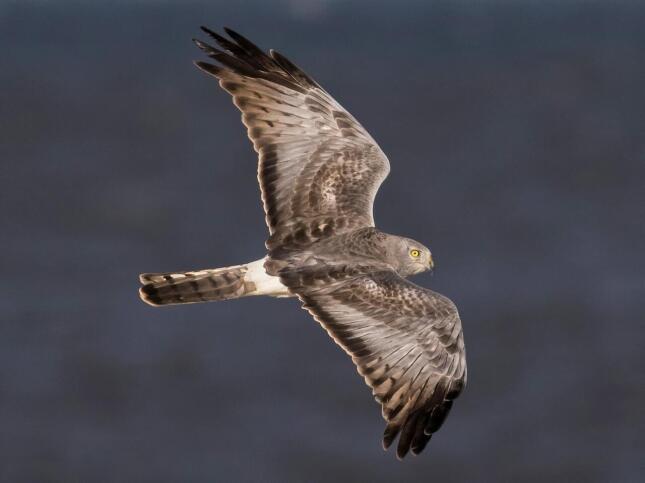
• The Northern Harrier is distinctive from a long distance away: a slim, long-tailed hawk gliding low over a marsh or grassland, holding its wings in a V- shape and sporting a white patch at the base of its tail. Up close it has an owlish face that helps it hear mice and voles beneath the vegetation. These unusual raptors have a broad distribution across North America.
• Northern Harriers are the most owl-like of hawks (though they’re not related to owls). They rely on hearing as well as vision to capture prey. The disk- shaped face looks and functions much like an owl’s, with stiff facial feather helping to direct sound to the ears.
• Breeding Northern Harriers are most common in large, undisturbed tracts of wetlands and grasslands with low, thick vegetation. They breed in freshwater and brackish marshes, lightly grazed meadows, old fields, tundra, dry upland prairies, drained marshlands, high-desert shrub steppe, and riverside woodlands across Canada and the northern United States.
• Northern Harriers forage on the wing, coursing low over the ground. Unlike other hawks, they rely heavily on their sense of hearing to capture prey. In the breeding season they eat small mammals, reptiles, amphibians and birds.
• Either the male or the female chooses the nest site, which is on the ground and usually in a dense clump of vegetation such as willows, grasses, sedges, reeds, bulrushes, and cattails.
• The oldest Northern Harrier on record was a female, and at least 15 years, 4 months old when she was captured and released in 2001 by a birdbander in Quebec. She was banded in New Jersey in 1986.